
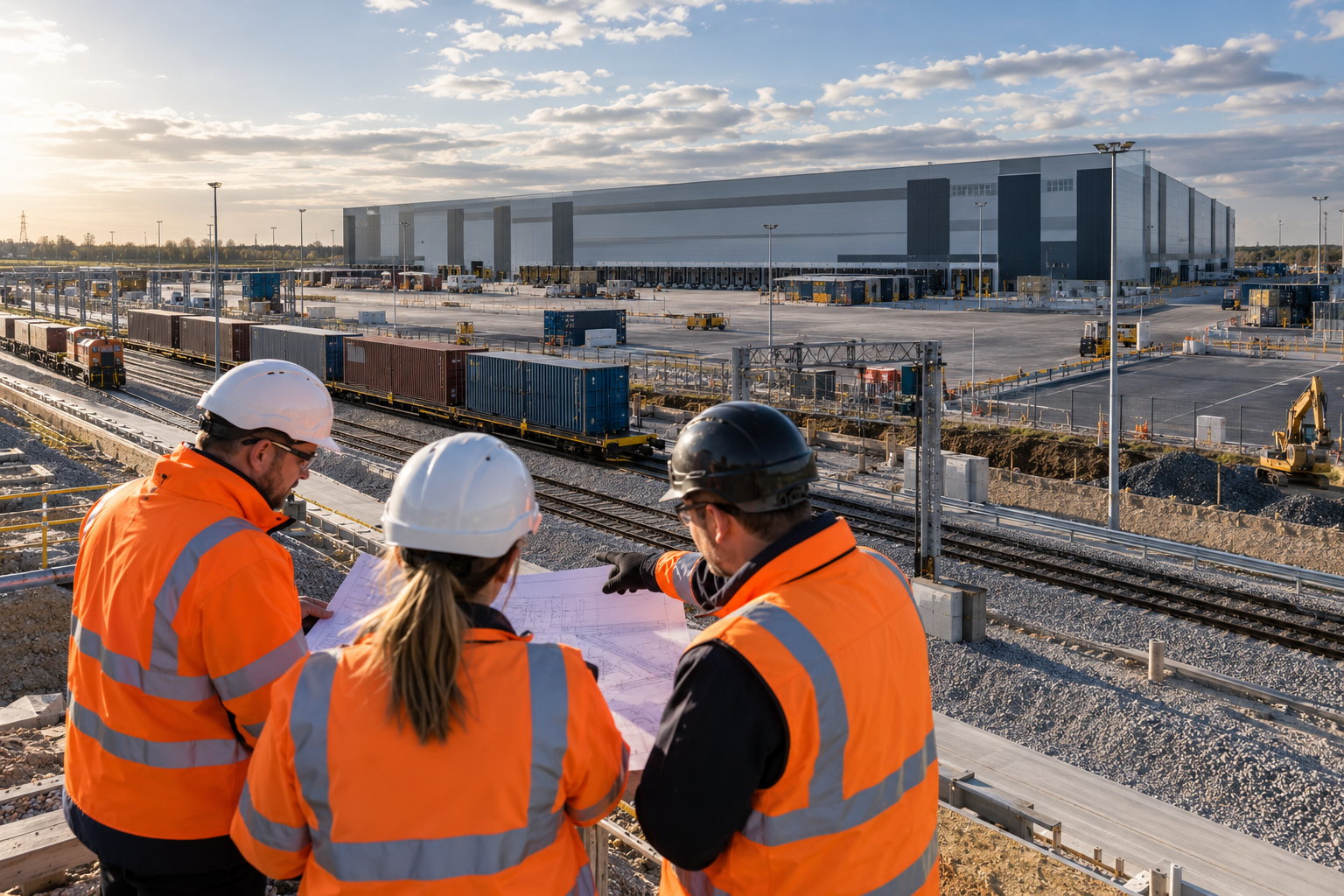
Supporting the delivery of a major rail-connected distribution development for Sainsbury’s at Daventry International Rail Freight Terminal.
Working within the wider VolkerFitzpatrick delivery team, JBA supported a complex design-and-build programme involving a large distribution centre, offices, intermodal rail infrastructure, highways, drainage, earthworks, and final fit-out integration. The project was delivered to support Sainsbury’s operational go-live in February 2015, while also achieving strong environmental performance standards.
Project Description - Delivering a Complex Distribution and Rail Infrastructure Programme
The Sainsbury’s DIRFT II development formed part of the Daventry International Rail Freight Terminal near Rugby, Warwickshire.
The programme involved the design and construction of a 1 million sq. ft. distribution centre, approximately 75,000 sq. ft. of office space, 770 parking spaces, and a 9,600 m² intermodal rail facility.
The scope also included significant enabling and infrastructure works, including demolition and remediation, large-scale earthworks, highways, drainage, a new rail bridge, and the construction of approximately 500 metres of railway on a 9-metre embankment.
JBA supported the project within a complex delivery environment where building construction, civil engineering, rail infrastructure, and operational fit-out all needed to be coordinated against a fixed go-live date.
The Challenge - Coordinating Multiple Workstreams Against a Fixed Operational Deadline
The scale of the development created a significant coordination challenge.
The programme involved multiple major workstreams, including building construction, earthworks, rail infrastructure, highways, drainage, remediation, and the later integration of operational fit-out activities.
More than 1 million m³ of cut-and-fill activity was required, alongside approximately 350,000 m³ of soil modification, adding further complexity to the site-development programme.
At the same time, Sainsbury’s needed certainty that the facility would be ready for operational use in February 2015.
The challenge was therefore not simply to complete the construction works, but to manage the interfaces between civil, structural, rail, building, and fit-out activities so that the overall programme remained aligned to the client’s operational requirements.
JBA's Approach
Integrated Programme Management
Fit-Out Integration
Delivery Control Across Complex Interfaces
Results & Impact - Delivering Operational Readiness on Schedule
The integrated programme approach gave Sainsbury’s confidence that the facility would be ready for its planned February 2015 go-live, while successfully coordinating major construction, rail, infrastructure, and fit-out activities within a single programme. The completed development included a 1 million sq. ft. distribution centre and a 9,600 m² intermodal rail facility, with a total project value of £110 million delivered over an 80-week programme. The development also achieved BREEAM “Excellent” and the best possible EPC rating, demonstrating strong environmental performance alongside successful programme delivery.