
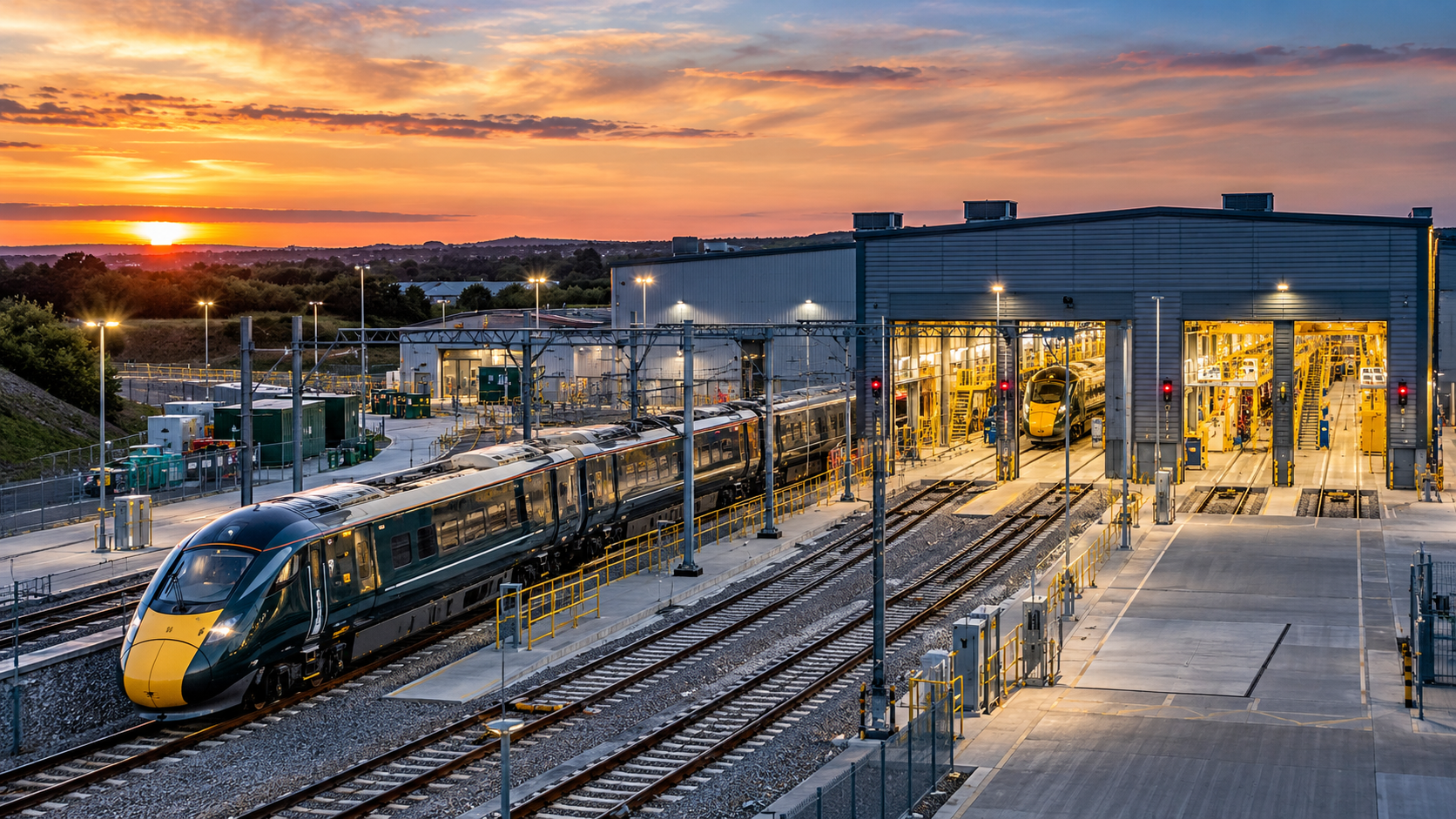
Supporting the delivery of a purpose-built rail maintenance and storage facility for Hitachi Rail Europe in Bristol.
JBA supported the development of the Stoke Gifford Intercity Express Depot, a complex brownfield rail construction project designed to accommodate, maintain, and service long-distance intercity express trains. The programme combined depot construction, rail infrastructure, signalling, overhead-line electrification, environmental remediation, and major civil engineering works within a highly coordinated delivery environment.
Project Description - Building a Modern Rail Maintenance Facility on a Complex Brownfield Site
The Stoke Gifford Intercity Express Depot was developed as a purpose-built facility for the storage, maintenance, and servicing of ten-car intercity express trains.
The completed depot included approximately 4,950 m² of floor space, with two raised maintenance roads, roof and platform access, 2.5-tonne monorail hoists, office and welfare facilities, a train wash, wheel lathe, and supporting operational amenities.
The project also included extensive permanent-way infrastructure, signalling, and overhead-line electrification constructed to Network Rail standards, together with three connections to the Great Western Main Line.
The depot was designed to support daytime maintenance activity and evening cleaning, helping provide the infrastructure required for reliable long-distance intercity operations.
The Challenge - Transforming a Contaminated Brownfield Site Into an Operational Rail Depot
The site had previously been used for concrete and aggregate recycling, creating a number of environmental and construction challenges.
Before major works could progress, the project required extensive contamination testing and remediation. Significant civil engineering was also needed to address drainage, floodwater management, noise mitigation, and the integration of the new depot with the existing rail network.
A major element of the project involved constructing approximately 500 metres of culvert, in places reaching depths of up to 15 metres, to manage floodwater across the site.
A 7-metre-high perimeter noise bund was also incorporated to reduce the impact of depot operations on the surrounding area.
The combination of remediation, deep civil works, railway systems, depot construction, and live-network interfaces required close coordination across multiple disciplines.
JBA's Approach
Integrated Project Coordination
Engineering & Rail Systems Integration
Managing a Complex Construction Environment
Results & Impact - Creating a Modern Depot for Intercity Rail Operations
The Stoke Gifford project successfully transformed a challenging brownfield site into a modern rail maintenance and storage facility supporting Hitachi Rail Europe’s intercity operations.
The completed programme delivered a 4,950 m² depot, major rail and electrification infrastructure, three Great Western Main Line connections, a dedicated train wash, wheel lathe, maintenance facilities, and substantial civil engineering works including the deep floodwater culvert and perimeter noise bund.
Construction ran from August 2012 to March 2016, with a peak workforce of more than 350 people.
The project’s standards of site management and delivery were also recognized with a Considerate Constructors Scheme National Gold Award.